
Water Heater Repair & Replacement
No hot water, lukewarm water, or a tank leaking at its base are three different failures with three different fixes. Diagnosis comes first — element, thermostat, gas control valve, sediment, anode or tank integrity — and only then a repair or a replacement scope, with a written flat-rate quote.
Call (607) 564-1499 — Talk to Dispatch
You get an itemized, written flat-rate quote before work starts. No surprise hourly billing.
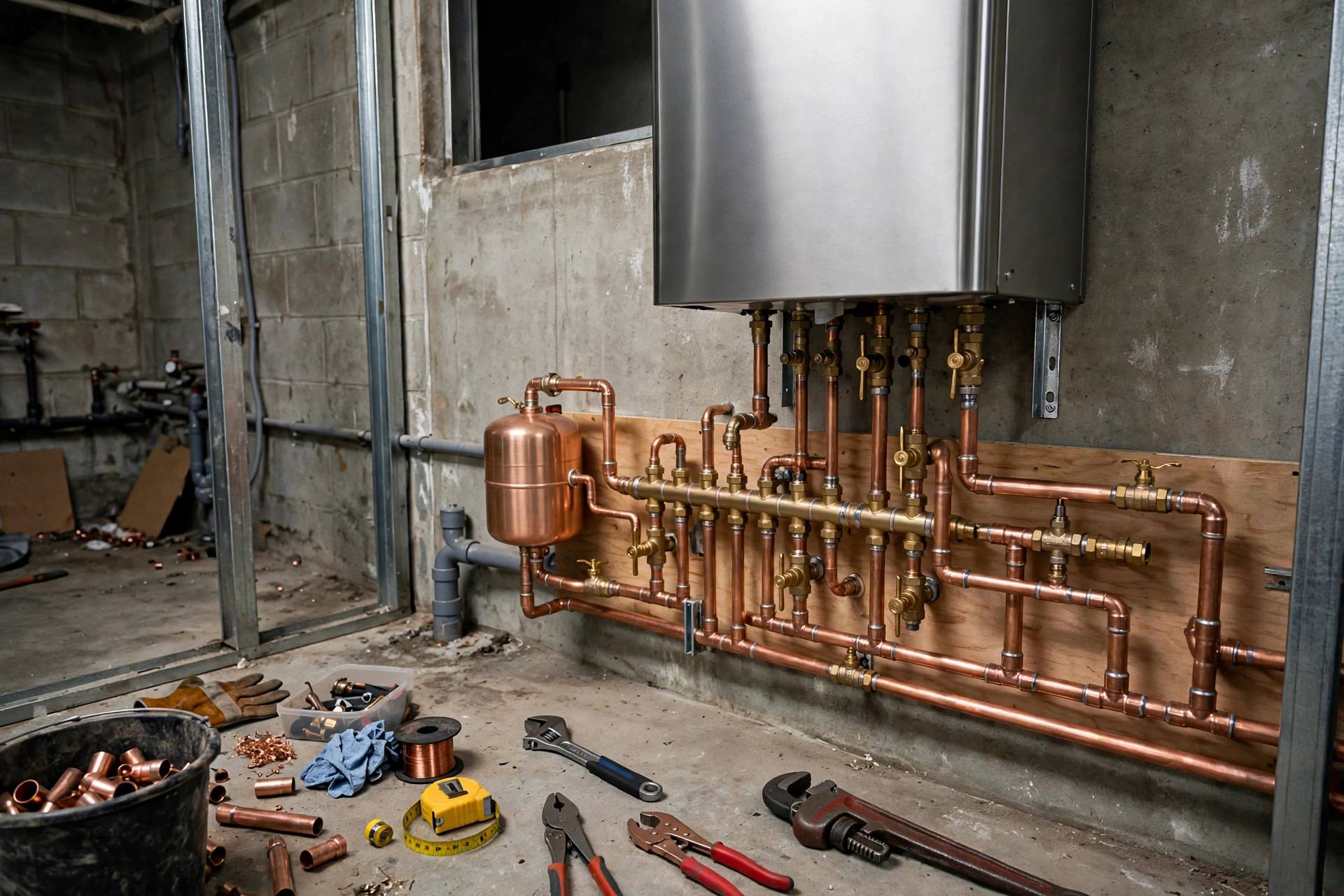
Representative preview image. It is not labelled as a real work photo; real job photos will replace representative images when supplied.
How a water heater visit works
- Confirm the symptom: no hot water, not enough hot water, discolored water, noise, or a visible leak.
- Test the heating source — electrical elements and thermostats, or gas control valve and burner — and check the temperature and pressure relief valve.
- Check sediment, anode rod condition and venting, because sediment and a spent anode shorten tank life.
- Repair the failed part where the tank is sound, or scope a replacement where the tank itself has failed.
- For a replacement, size the unit to the home, fit dedicated venting for a condensing tankless unit, and test continuous hot water before leaving.
What the technician checks first
- Whether the tank is leaking from a fitting, which can be repaired, or from the tank seam, which cannot.
- Anode rod condition — total sacrificial anode failure leads to galvanic pitting and bottom weld seam failure.
- Sediment build-up, which causes rumbling, slow recovery and wasted energy.
- Gas and venting safety for gas units, and electrical supply for electric units.
Tank or tankless? A practical comparison
A sound tank with a failed element or thermostat is usually a repair. A tank with base corrosion and an 11-year service life, as in one recent conversion case, is a replacement candidate. A 199,000 BTU/hr, 96% AFUE condensing tankless unit gives continuous domestic hot water and Energy Star certified installation, but it needs dedicated venting and correct sizing — it is not a like-for-like swap in every home.
Questions customers ask about this service
Why is my water only lukewarm?
Common causes are a failed lower element, a thermostat set or failed, heavy sediment insulating the tank bottom, or a unit undersized for peak demand. Testing separates those causes quickly.
How long should a tank last?
Life depends on water quality, anode maintenance and sediment. A tank leaking at the bottom seam has reached the end of its service life, even if the burner or elements still work.
Does a tankless unit need special venting?
A condensing tankless unit needs dedicated venting and condensate handling, which is part of the replacement scope and quote, not an afterthought.
Related services and areas
Hydro-Jetting
A related service from the same team.
Emergency Plumbing
A related service from the same team.
Drain Cleaning & CCTV
A related service from the same team.
Leak Detection
A related service from the same team.
Sump Pump Systems
A related service from the same team.
Ithaca
Water heater help in this area.
Lansing
Water heater help in this area.
Dryden
Water heater help in this area.
Cortland
Water heater help in this area.
Binghamton
Water heater help in this area.
Tompkins County
Water heater help in this area.